Runhe-Cast-Iron-Gear-Pump-Whitepaper
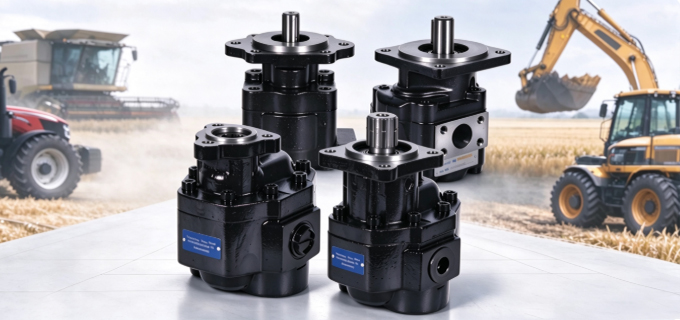
Cast Iron Gear Pumps Built for the Real World: Why Runhe Hydraulic Is the Smart Alternative to Parker PGP Series
A Runhe Hydraulic White Paper — Cast Iron Gear Pumps, Parker-Interchangeable, Factory-Direct from China
Hebei Runhe Hydraulic Machinery Co., Ltd. | www.hydraulicpumptech.com
Suggested meta description for web publishing (SEO): Runhe Hydraulic manufactures cast iron gear pumps fully interchangeable with Parker PGP315, PGP330, PGP350, PGP365, PGP020/021, PGP031, PGP051 and PGP076 series — same mounting, same spare parts, better price, faster delivery. OEM-quality aftermarket hydraulic gear pumps for dump trucks, construction, agriculture and industrial hydraulics.
Executive Summary
Every fleet manager, hydraulic distributor, and equipment OEM who buys cast iron gear pumps faces the same equation: Parker Hannifin's PGP series is the global benchmark for heavy-duty external gear pumps — but benchmark quality increasingly comes with benchmark pricing and lead times that can stretch to 168 business days at authorized distributors ( Hydradyne). Meanwhile, the global gear pump market keeps growing — from USD 4.9 billion in 2025 toward USD 5.82 billion by 2031 ( Mordor Intelligence) — and buyers who cannot wait six months for a replacement pump are actively searching for a Parker-interchangeable cast iron gear pump that bolts on, performs, and ships fast.
This white paper explains why Runhe Hydraulic's cast iron gear pump range — covering the 315, 330, 350, 365, 020/021, 031, 051 and 076 series — is engineered to be that answer. Runhe pumps match Parker PGP/PG series units dimension-for-dimension: mounting flanges are installation-compatible, and internal repair parts are interchangeable, so a Runhe pump drops into an existing circuit without re-engineering, and a Runhe seal kit, gear set, bushing or thrust plate can service a Parker pump already in the field. On top of that mechanical equivalence, Runhe adds the three advantages that decide real-world purchasing: proven quality at a rational price, delivery measured in weeks rather than months, and the full strength of China's hydraulic supply chain behind every order.
Whether you are an equipment owner searching for a "Parker PGP330 replacement," a repair shop that needs interchangeable gear pump spare parts, a distributor building a private-label line, or an OEM sourcing cast iron gear pumps at scale, this document gives you the technical comparison, the market context, and a practical selection framework — plus direct answers to the questions buyers ask most.
1. The Market Context: Cast Iron Gear Pumps Are a Growing, Under-Served Opportunity
1.1 A multi-billion-dollar market with durable fundamentals
Hydraulic power remains the muscle of mobile and industrial machinery, and gear pumps are its most widely used heart. The global hydraulic pumps market was valued at USD 11.53 billion in 2025 and is projected to reach USD 16.35 billion by 2034 at a 3.95% CAGR ( Fortune Business Insights). Within that, gear pumps form a resilient segment estimated at USD 4.9 billion in 2025, forecast to grow to USD 5.82 billion by 2031 ( Mordor Intelligence); independent analyses converge on roughly USD 6.5 billion by 2035 at a ~2.9% CAGR ( Precedence Research, Market Research Future).

The structure of that demand favors exactly the product class this white paper covers. External gear pumps hold about 61.8% of the gear pump market, fixed-displacement designs account for roughly 71.5%, and cast iron is the single largest housing material at 50.9% of 2025 revenue ( Mordor Intelligence). A dedicated hydraulic gear pump analysis likewise projects cast iron units to hold about 46% share in 2026, with external gear designs at 55% ( Future Market Insights). In plain terms: the heavy-duty, cast iron, fixed-displacement external gear pump is not a legacy niche — it is the largest single slice of a growing market.
1.2 Where the demand comes from — and why Asia-Pacific supply matters
Regionally, Asia-Pacific leads the gear pump market with a 35.3% revenue share in 2025, driven by construction, agriculture and mobile machinery build-outs ( Mordor Intelligence); the broader hydraulics market shows the same pattern, with Asia-Pacific holding 38.4% of 2024 revenue and construction as the largest end-use industry ( MarketsandMarkets). Country-level forecasts put China among the fastest-growing hydraulic gear pump markets at a 4.8% CAGR through 2036 ( Future Market Insights).
For buyers in North America and Europe — still the largest replacement-pump markets — this geography has a decisive practical meaning. The pump on a dump truck in Texas or a wheel loader in Bavaria was very likely built on a Parker/Commercial Intertech pattern, and the cost-efficient way to keep it running is a dimensionally interchangeable replacement sourced from a Chinese manufacturer with a complete casting, machining and heat-treatment supply chain. Chinese hydraulic manufacturers' integrated supply chains typically deliver prices 20–40% below Western equivalents with fast, logistics-optimized delivery ( StrongFlex). That is precisely the gap Runhe Hydraulic was built to fill.
2. Why Cast Iron Gear Pumps Remain the Workhorse of Mobile Hydraulics
2.1 The engineering case for cast iron construction
Aluminum gear pumps dominate light industrial circuits, but when the application involves pressure cycling, shock loads, contamination and outdoor duty, the industry standard is the three-piece cast iron external gear pump. Cast iron housings provide the rigidity and power-to-weight ratio needed for sustained high-pressure work, while balanced thrust plates minimize friction and internal leakage, and low-friction bushings or roller bearings carry the radial loads of heavy-duty service ( Heash Technique). This is the architecture behind Parker's PG020-series "vocational truck, winch and oil & gas" positioning — high durability and resistance to oil contamination in exactly the environments where aluminum pumps fatigue ( Parker).
The bushing-type 300 series pushes the formula further: three-piece cast iron construction with large-area, low-friction bushings delivers strength, high efficiency and long life in severe operating environments, with single, multiple, piggyback and thru-drive assemblies up to six pumping sections ( Hydratorque). Volumetric efficiencies reach up to 98% in the PGP315–365 family at speeds up to 3,000 rpm ( Poocca). Runhe Hydraulic manufactures to this same architecture — same pressure-balanced thrust plate principle, same bushing and bearing options, same SAE/ISO/DIN mounting ecosystem — so customers keep every engineering benefit of the proven design.
2.2 The total-cost case: a pump you can actually repair
A second, often overlooked reason cast iron gear pumps dominate the aftermarket is serviceability. Unlike sealed throwaway units, a three-piece gear pump can be disassembled, inspected and rebuilt with bushings, thrust plates, seals and gear sets — Parker's own PGP300 service manual documents the full teardown and rebuild procedure ( Parker service manual). A mature global ecosystem of interchangeable spare parts exists for exactly these series, with component suppliers offering gear housings, bearing carriers, thrust plates and seal kits that interchange 100% with Parker Commercial P30/31, P50/51, P75/76 and P315–P365 pumps ( DYNACO via EC21).
Runhe Hydraulic participates fully in this ecosystem: Runhe repair parts interchange with Parker originals, which means a distributor can stock one parts line to service both brands, a repair shop can rebuild a customer's Parker pump with Runhe components, and an end user is never locked into a single source for the wearing parts that determine lifecycle cost. Over a machine's life, parts availability and rebuildability routinely matter more than the initial purchase price — and they are areas where Runhe's factory-direct model converts directly into customer savings.
3. The Runhe Product Family: Eight Series, One Interchange Standard
3.1 Portfolio overview and coverage map
Runhe Hydraulic's cast iron gear pump portfolio mirrors the complete Parker heavy-duty lineup in two engineering families. The bushing-type high-pressure family (315 / 330 / 350 / 365) covers continuous ratings up to 241 bar (3,500 psi) and speeds to 3,000 rpm, spanning displacements from 7.6 to 147.5 cc/rev. The roller-bearing family (020/021 / 031 / 051 / 076) covers up to 207 bar (3,000 psi) at speeds to 2,400 rpm, extending displacement coverage all the way to 202 cc/rev for the largest vocational-truck and oilfield circuits ( Heash Technique, Western Intech).
Together the eight series cover 7.6–202 cc/rev with no gaps a buyer will ever hit in practice: small auxiliary and steering circuits at the bottom, mainstream loader/forklift/sanitation-vehicle circuits in the middle, and high-flow dump, mining and winch circuits at the top. Every series is available in single, tandem and multiple-pump configurations, with CW, CCW and bi-rotational options, SAE and ISO shafts, flanges and porting, and integrated valve options including relief with anti-cavitation check, priority flow control, unloader valves and accumulator charge functions ( Poocca, Heash Technique).
3.2 High-pressure bushing-type series: 315, 330, 350, 365
These four frame sizes are the heavy-duty core of the portfolio, designed for frequent pressure reversals and continuous heavy loading in construction machinery, mining and petroleum applications ( Versen):
Series | Displacement range | Max continuous pressure | Max speed | Typical flow per section | Weight (single) | Typical applications |
PGP 315 | 7.6–40.6 cc/rev (0.46–2.48 in³/r) | 241 bar (3,500 psi) | 3,000 rpm | to 32 GPM (121 LPM) | 12.5–15.2 kg | Small agricultural machinery, sanitation vehicles, auxiliary circuits ( Versen) |
PGP 330 | 16.1–64.6 cc/rev (0.985–3.94 in³/r) | 241 bar (207 bar at 64.6 cc) | 3,000 rpm | to 40 GPM (151 LPM) | 15.2–19 kg | Loaders, forklifts, wash trucks, mid-size industrial systems — the market's most-used frame ( Versen) |
PGP 350 | 20.8–104 cc/rev (1.275–6.375 in³/r) | 241 bar (224 bar at 104 cc) | 3,000 rpm | to 66 GPM (250 LPM) | 19–26 kg | Excavator auxiliary pumps, large sanitation vehicles, conveyors ( Poocca) |
PGP 365 | 44.3–147.5 cc/rev (2.7–9.0 in³/r) | 241 bar (207 bar at 147.5 cc) | 2,400 rpm | to 93.5 GPM (354 LPM) | 24.3–32.2 kg | Large loaders, road rollers, heavy industrial main pumps ( Versen) |
All four share the same three-piece cast iron construction, low-friction bushing design and pressure-balanced thrust plates, accept SAE/ISO/DIN mountings, and can be combined freely into multiple assemblies — a 330+315 tandem, for example, or piggyback combinations across frame sizes sharing a common inlet ( Hydratorque). Because Runhe machines every interface to the original dimensional standards, a Runhe 330 bolts directly onto the SAE 2-bolt or 4-bolt flange where a Parker PGP330 sat, with the same shaft, the same port threads and the same rotation options.
3.3 Roller-bearing series: 020/021, 031, 051, 076
The roller-bearing family is the vocational-truck and oilfield workhorse, prized for contamination tolerance and durability in winch, dump and PTO-driven service ( Heash Technique):
Series | Displacement range | Max continuous pressure | Max speed | Flow per section | Distinctive features |
PGP 020/021 | 16.2–64.6 cc/rev (0.985–3.94 in³/r) | 207 bar (3,000 psi) | 2,400 rpm | to 38.4 GPM (145 LPM) | Roller bearings, three-piece cast iron, multiple sections ( Parker) |
PGP 031 | 16.2–64.6 cc/rev | 207 bar (3,000 psi) | 2,400 rpm | to 38.4 GPM (145 LPM) | Integral valve options: relief w/ anti-cavitation, priority, unloader, two-speed ( Heash Technique) |
PGP 051 | 21–105 cc/rev (1.275–6.375 in³/r) | 207 bar (3,000 psi) | 2,400 rpm | to 63 GPM (238.5 LPM) | Integral valve options, piggyback assemblies ( Commercial Hydraulics catalog) |
PGP 076 | 50–202 cc/rev (3.07–12.3 in³/r) | 207 bar (3,000 psi) | 2,400 rpm | to 121.4 GPM (459.5 LPM) | Largest roller-bearing frame; high-flow dump and oilfield duty ( Heash Technique) |
These series correspond to the legacy Commercial Intertech P20/P21, P30/P31, P50/P51 and P75/P76 nomenclature that still dominates parts counters and machine manuals worldwide — an important cross-reference point covered in Section 5. For buyers maintaining aging fleets, Runhe's ability to supply both the modern PGP-pattern pump and the interchangeable internals for the legacy P-series unit on the same machine is a genuine one-stop advantage.
4. Runhe vs. Parker: An Honest Head-to-Head Comparison
4.1 Where the products are equivalent — by design
Runhe does not ask customers to trade down. The engineering target is functional and dimensional equivalence with the Parker original, verified at the interface level: mounting flange patterns, pilot diameters, shaft splines and keyways, port sizes and locations, rotation options, and the internal wearing parts. Independent aftermarket suppliers confirm the interchangeability of this entire product class — equivalent pumps and 100% interchangeable components for P30/31, P50/51, P75/76 and P315–P365 are an established, mature market category ( Green Hydraulic, DYNACO via EC21) — and Runhe manufactures to the same OEM dimensional standards, with each unit pressure-tested and flow-verified before dispatch.
Comparison dimension | Parker PGP/PG original | Runhe Hydraulic equivalent |
Mounting flange & pilot | SAE 2-/4-bolt, ISO, DIN patterns | Identical patterns — direct bolt-on interchange |
Shaft options | SAE splined, keyed, tapered | Same options, same dimensions |
Porting | SAE split flange, NPT, BSPP, ODT; side/rear | Same port types and locations |
Displacement coverage | 7.6–202 cc/rev across the 8 series | Same coverage, series-for-series |
Pressure ratings | up to 241 bar (300 series) / 207 bar (bearing series) | Matched ratings by displacement code |
Repair parts | Genuine Parker parts network | Runhe parts interchangeable with Parker internals |
Multiple/tandem assemblies | Up to 6 sections, piggyback, thru-drive | Same modular combinations available |
Integrated valves | Relief, priority, unloader, load-sense, two-speed | Same valve option families |
4.2 Where Runhe wins: price, delivery and supply-chain depth
The differences that decide a purchase order sit outside the nameplate. Genuine Parker gear pumps sold through distribution routinely command USD 495 and up per unit on the open market ( eBay Parker gear pumps), and factory lead times at authorized channels have been quoted as long as 168 business days amid supply-chain shortages ( Hydradyne). Comparable Chinese-manufactured equivalents in the PGP315–365 class transact in the USD 35–400 range on global B2B platforms ( Alibaba), and competitive Chinese factories quote standard delivery of 15–30 days, with small orders shipping within a week ( Made-in-China).
Runhe Hydraulic's offer is built on exactly these mechanics, executed from inside China's deepest hydraulic manufacturing region. As a subsidiary of Hanjiu Technology Group with more than 12 years of industry experience, Hebei Runhe Hydraulic Machinery integrates R&D, manufacturing and sales of hydraulic pumps, motors and cylinders, supplying large OEM equipment manufacturers domestically and exporting worldwide ( Made-in-China company profile). The result for the customer is a simple, powerful proposition: OEM-pattern quality, a rational factory-direct price, and delivery fast enough to keep machines working — backed by a supply chain that can scale from a single replacement pump to container-load OEM programs without changing suppliers.
4.3 What this means for each type of buyer
For end users and fleet operators, the value is uptime: a failed pump on a dump truck or loader stops revenue, and waiting months for an OEM unit is not a plan. A Runhe interchangeable pump — or a Runhe seal-and-bushing rebuild kit for the existing Parker unit — restores the machine in days at a fraction of the replacement cost. For repair shops and service companies, parts interchangeability is the business model: one inventory of Runhe components services the entire installed base of Parker Commercial-pattern pumps, from P30-series legacy units to current PGP365s.
For distributors and resellers, Runhe functions as a private-label manufacturing partner: factory-direct pricing leaves real margin, the eight-series portfolio covers the whole heavy-duty gear pump category with one supplier, and customization (nameplates, packaging, port forms, special materials) is a standard service rather than an exception — Runhe explicitly offers non-standard customization to customer drawings, including special ports, materials, installations and performance requirements ( Made-in-China company profile). For equipment OEMs, the combination of drawing-level customization, batch consistency from an integrated casting-to-assembly chain, and pricing 20–40% below Western-branded equivalents ( StrongFlex) makes Runhe a credible dual-sourcing or primary-sourcing partner for new machine programs.
5. Interchange & Cross-Reference Guide
5.1 Series-to-series mapping
The table below maps the Runhe range against the Parker/Commercial nomenclature buyers actually search for — including the legacy names that still dominate service manuals. Displacement and pressure data are the published Parker-pattern ratings that Runhe equivalents are built to match ( Heash Technique, Poocca, Western Intech).
Runhe series | Parker current designation | Legacy Commercial/Metaris designation | Displacement (cc/rev) | Max pressure | Bearing type |
315 | PGP315 / PGM315 | P315 | 7.6–40.6 | 241 bar / 3,500 psi | Bushing |
330 | PGP330 / PGM330 | P330 | 16.1–64.6 | 241 bar / 3,500 psi | Bushing |
350 | PGP350 / PGM350 | P350 | 20.8–104 | 241 bar / 3,500 psi | Bushing |
365 | PGP365 / PGM365 | P365 | 44.3–147.5 | 241 bar / 3,500 psi | Bushing |
020/021 | PGP020 / PGP021 | P20 / P21 | 16.2–64.6 | 207 bar / 3,000 psi | Roller |
031 | PGP031 (PGP030/031 family) | P30 / P31 | 16.2–64.6 | 207 bar / 3,000 psi | Roller |
051 | PGP051 (PGP050/051 family) | P50 / P51 | 21–105 | 207 bar / 3,000 psi | Roller |
076 | PGP076 (PGP075/076 family) | P75 / P76 | 50–202 | 207 bar / 3,000 psi | Roller |
Third-party interchange guides confirm that gear sets, housings, thrust plates, seals and bearings across these series form a 100%-interchangeable global parts standard spanning Parker Commercial, Metaris, Permco and Muncie patterns ( DYNACO via EC21, CRS crossover guide). Runhe pumps and parts are manufactured into this same standard.
5.2 How to specify the right Runhe replacement in five steps
Replacing a Parker-pattern pump with a Runhe unit is a checklist exercise, not an engineering project. The ordering logic follows the same coding structure as the original — series/frame size, rotation, displacement code, mounting flange, shaft type, port configuration, seals and valve options ( Versen):
1. Read the nameplate or measure the old pump. Note the series (e.g., PGP330), displacement code, rotation and any valve suffix. If the nameplate is gone, the flange pattern, shaft and port sizes identify the frame size.
2. Confirm displacement and pressure. Match the cc/rev code; remember the top displacement codes in each frame carry a reduced pressure rating (e.g., 330 at 64.6 cc → 207 bar).
3. Match the mechanical interfaces. Flange (SAE 2-/4-bolt, ISO), shaft (spline/key/taper), port type and location (side/rear).
4. Decide: replacement or rebuild. If the original pump body is sound, a Runhe repair kit (bushings, thrust plates, seals, gear set) may be the faster, cheaper fix — the parts interchange.
5. Send Runhe the model number, photos or drawing. Runhe's engineering team confirms the interchange and issues a datasheet before order — the same verification workflow that leading aftermarket suppliers use ( Hydro Gear Tech).
6. Applications: Where Runhe Cast Iron Gear Pumps Earn Their Keep
6.1 Mobile and vocational hydraulics
The natural home of these eight series is mobile equipment, where cost and contamination tolerance decide component selection ( Western Intech). PTO-driven dump trucks and tippers rely on cast iron gear pumps to lift loaded bodies cycle after cycle in dust, heat and shock; loaders, forklifts, excavator auxiliary circuits, road rollers, sanitation and wash trucks, agricultural tractors and harvesters, forestry machinery and winches all sit squarely in the 020–076 and 315–365 envelope ( Hyleman via Made-in-China, Adiffer). Construction remains the largest end-use industry in the hydraulics market overall ( MarketsandMarkets), and the U.S. replacement market specifically rewards suppliers offering direct replacements with limited lead times ( Future Market Insights) — Runhe's core competency.
Beyond pumps, Runhe's broader range — hydraulic motors, hydraulic cylinders for agricultural machinery, excavators and dump trucks, and control valves — lets equipment builders consolidate a machine's whole hydraulic bill of materials with one factory ( ecer.com company listing). Fewer suppliers means simpler logistics, consistent quality documentation, and one accountable partner for the hydraulic system as a whole.
6.2 Industrial and energy applications
In stationary and energy applications, the same pumps serve hydraulic power units, presses, machine tools, oilfield and drilling support equipment, marine and port machinery, mining equipment and steel-plant auxiliaries — the segments where the roller-bearing 020–076 family's contamination resistance and the 300-series' 241-bar continuous rating matter most ( Heash Technique, Hyleman via Made-in-China). Oil & gas alone accounts for about 29% of gear-pump demand ( Mordor Intelligence), and fire-resistant fluid compatibility (water-glycol HFC, phosphate-ester HFD with FPM seals) is documented for the product class ( Parker PGP315 specifications) — options Runhe supports through its customization service.
For plants running mixed fleets of aging Parker/Commercial equipment, Runhe's dual capability — complete interchangeable pumps plus interchangeable repair parts — turns a chronic maintenance headache into a routine procurement line item, with the economic structure of Chinese manufacturing (20–40% cost advantage) flowing straight to the maintenance budget ( StrongFlex).
7. Quality, Testing and the China Supply-Chain Advantage
7.1 How Runhe builds quality in
"Reasonable price" only creates value if quality holds. Runhe's quality model rests on four pillars: design fidelity (manufacture to the original dimensional and material standards so that form, fit and function match the Parker pattern); process control (integrated casting, machining, heat treatment and assembly under one quality system); verification (pressure and flow testing of finished units, in line with the testing practices that credible Chinese aftermarket manufacturers describe — pressure-tested and flow-verified per unit, with batch test reports available ( Hydro Gear Tech)); and service (technical support for pump selection, interchange confirmation and commissioning, as Runhe highlights in its own company materials ( hydraulicpumptech.com)).
The group structure adds resilience: as part of Hanjiu Technology Group, Runhe pairs its 12+ years of hydraulic manufacturing experience with the engineering depth to customize ports, materials, mountings and performance characteristics to customer drawings, serving industries from automation and agriculture to lifting machinery, port and marine applications ( Made-in-China company profile). "Survival by quality, development by integrity" is the company's stated operating philosophy — and in the interchangeable-parts business, where every shipment is a direct physical comparison with the OEM original, quality is not a slogan but the entire basis of repeat orders.
7.2 Why the Chinese supply chain wins on speed and cost
China's hydraulic component industry has matured into a complete ecosystem — foundries, gear-hobbing and grinding capacity, heat-treatment lines, seal and bearing supply, and export logistics concentrated in manufacturing provinces like Hebei and Shandong ( StrongFlex). That concentration is what allows a Runhe order to move from casting to container in weeks, at price points Western-branded channels structurally cannot match, while still meeting ISO/SAE/DIN dimensional and performance standards.
The contrast with the branded channel is stark and well documented: buyers report OEM lead times of 12 weeks and more as routine ( TSA Hydraulics), with extreme cases of 168 business days ( Hydradyne), while Chinese factories quote 15–30 day standard delivery and one-week dispatch for small orders ( Made-in-China). For a distributor deciding how much capital to tie up in inventory, or a mine deciding how long a loader sits idle, that difference is not a detail — it is the decision. Runhe Hydraulic exists to put China's supply-chain performance behind a product that matches the global benchmark dimension for dimension.
8. Frequently Asked Questions (Buyer & Engineer FAQ)
Are Runhe cast iron gear pumps really interchangeable with Parker PGP pumps?
Yes. Runhe's 315, 330, 350, 365, 020/021, 031, 051 and 076 series are manufactured to the Parker/Commercial dimensional standard — identical mounting flanges, pilots, shafts, ports and rotation options — so they install as direct replacements without adapters or circuit changes. Interchangeability of this product class is an established industry standard, with multiple global suppliers offering 100%-interchangeable pumps and components for the same series ( Green Hydraulic, DYNACO via EC21).
Can I repair a Parker pump with Runhe spare parts?
Yes — this is one of Runhe's most practical advantages. Bushings, thrust plates, gear sets, shafts, seals and housings for the PGP/PGM 315–365 and P20–P76 families are interchangeable components across the industry ( CRS crossover guide), and Runhe supplies them to the same standard. A repair shop can therefore rebuild a customer's genuine Parker pump using Runhe parts, or stock one parts line to service both brands.
What pressure and displacement can Runhe gear pumps cover?
The bushing-type 315/330/350/365 series cover 7.6–147.5 cc/rev at up to 241 bar (3,500 psi) continuous and speeds to 3,000 rpm; the roller-bearing 020/021/031/051/076 series cover 16.2–202 cc/rev at up to 207 bar (3,000 psi) and 2,400 rpm — matching the published Parker-pattern ratings series for series ( Poocca, Heash Technique).
How fast can Runhe deliver, and what is the minimum order?
Runhe ships from inside China's concentrated hydraulic supply chain, where 15–30 day standard delivery and one-week small-order dispatch are the industry norm ( Made-in-China) — against branded-channel lead times that can reach months ( Hydradyne). Single-unit replacement orders, distributor stocking programs and OEM volume programs are all supported; contact the factory with your model list for current stock and lead time.
Does Runhe support OEM customization and private label?
Yes. Runhe routinely manufactures to customer drawings — special port forms, special materials, special mountings, special performance characteristics — and supports customized branding and packaging for distributors building their own lines ( Made-in-China company profile).
Which industries use Runhe gear pumps?
Dump trucks and tippers, construction machinery (loaders, excavators, rollers), agriculture, forklifts and material handling, sanitation vehicles, mining, oil & gas, forestry, marine and port equipment, and industrial hydraulic power units — essentially every application segment where cast iron external gear pumps are the standard choice ( Hyleman via Made-in-China).
9. Conclusion and Next Steps
The cast iron gear pump market is growing steadily toward USD 6.5 billion by 2035 ( Precedence Research), and the largest, most durable slice of it — heavy-duty, cast iron, fixed-displacement external gear pumps — is exactly where Runhe Hydraulic concentrates its manufacturing. The benchmark design is proven; what buyers need is a source that delivers that design without the benchmark price and the benchmark wait.
Runhe's answer is complete: eight series covering 7.6–202 cc/rev, installation-compatible with Parker PGP/PG pumps, repair parts interchangeable with Parker internals, OEM-pattern quality verified by testing, factory-direct pricing, and delivery in weeks powered by China's hydraulic supply chain. For equipment users, that means uptime; for service companies, a single parts inventory; for distributors, margin and a private-label partner; for OEMs, a scalable dual-source with drawing-level customization.
Ready to compare? Send your Parker model number, a photo of the nameplate, or your drawing — Runhe's engineers will confirm the exact interchange and quote within one working day.
Hebei Runhe Hydraulic Machinery Co., Ltd. Website: www.hydraulicpumptech.com Product lines: cast iron gear pumps (315 / 330 / 350 / 365 / 020 / 021 / 031 / 051 / 076 series), gear motors, hydraulic cylinders, hydraulic control valves, pump spare parts Serving: equipment OEMs, hydraulic distributors, repair & service companies, fleet operators worldwide
This white paper is provided by Runhe Hydraulic for general informational and marketing purposes. Parker, PGP, PGM, Commercial Intertech, Metaris, Permco and Muncie are trademarks of their respective owners; references are for interchange identification only and do not imply affiliation or endorsement. Performance ratings cited are published industry values for the corresponding product series; final selection for any application should be confirmed with Runhe's engineering team.