Technical Overview of Tipper Truck Multi‑Stage Telescopic Hydraulic Cylinder
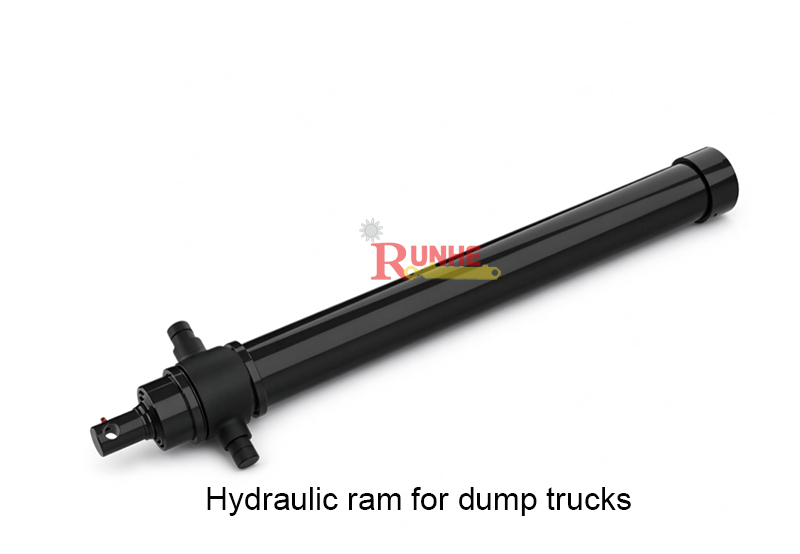
Hydraulic ram for dump trucks
First, Product Overview
The hydraulic ram for dump trucks is the core actuator in a dump truck’s hydraulic system and is classified as a multi-stage, single-acting telescopic hydraulic cylinder. It converts the hydraulic pressure energy delivered by the hydraulic pump into linear mechanical thrust, lifting the load bed to enable tipping and unloading; Upon pressure relief, the body returns to its original position under its own weight. It is widely used in engineering dump lorries, mining dump lorries, construction waste transport lorries and agricultural tipper lorries. Key features: a multi-stage nested cylinder structure, short length when retracted, minimal installation space required, and a large lifting stroke when extended, perfectly suited to the confined installation space of dump lorry chassis.
Second, Basic Structure
1. Multi-stage cylinder (sleeve): Multi-layered nested high-strength alloy steel tubes, typically made from high-strength steels such as 27SiMn, with precision roll-formed inner bores. These are pressure-resistant and impact-resistant, serving as the primary load-bearing component.
2. Piston rod/plungers at each stage: The rod surface is case-hardened and hard-chromium plated, providing wear resistance and protection against scratches from mud and sand; the mining version offers an optional laser cladding reinforcement process.
3. Sealing assemblies: Polyurethane main seals, dust seals and buffer seals prevent internal and external leakage, whilst blocking the ingress of construction site dust and muddy water into the cylinder body.
4. Guide sleeves and pivot brackets: The upper and lower pivot brackets connect the chassis to the load bed respectively; the spherical pivot structure absorbs off-centre loads caused by vehicle vibrations, preventing damage to the hydraulic cylinder from lateral forces.
5. Built-in cushioning mechanism: Provides cushioning at the end of the lifting stroke to prevent hard impacts between the sleeves at each stage; works in conjunction with the external balancing valve to control the cargo bed’s descent speed, preventing safety incidents caused by rapid free-fall.
Third, Operating Principle
The vast majority of tipper truck lifting cylinders are single-acting:
1. Lifting: The engine’s power take-off (PTO) drives the hydraulic pump; high-pressure oil enters the lower chamber of the cylinder, and the pressurised oil pushes the first-stage sleeve—which has the largest diameter—to extend first. Once this stage has completed its stroke, the pressure automatically switches to the next stage, extending them sequentially to lift the load bed. The larger-bore cylinder provides the initial force; during the initial lifting phase, the load is greatest and the thrust is strongest.
2. Lowering: The hydraulic pump relieves pressure and the control valve opens; the body’s own weight causes the sleeves to retract sequentially from the smallest to the largest diameter, whilst the hydraulic oil flows back to the reservoir; the balancing valve throttles the flow to limit speed, ensuring a smooth and gradual lowering of the body and preventing a sudden plunge.
Fourth, Product Classification
1. Front-mounted cylinders (FC): Installed behind the cab and at the front end of the body. The market standard, featuring multi-stage telescoping, high lifting torque and strong load-bearing capacity; suitable for heavy-duty engineering tippers and mining lorries.
2. Centre-mounted cylinders (centre cylinders): Positioned beneath the centre of the tipper body; generally two-stage cylinders with a simple structure and low cost, commonly used in light-duty tippers and agricultural tipper lorries.
3. Side-tipping cylinders: Arranged laterally, used in side-tipping tippers, generally employed in pairs.
Fifth, Performance Advantages
1. Long stroke, compact retracted dimensions: Multi-stage sleeve design enables a large tipping angle within a short installation space;
2. High load-bearing capacity: High cross-sectional force during the initial lifting phase ensures stable lifting under full load;
3. Resistance to off-centre loads: Spherical hinge combined with a long guide structure accommodates lateral misalignment during vehicle travel and lifting;
4. Strong environmental adaptability: Dust-proof and wear-resistant coatings ensure suitability for harsh environments such as mines, construction sites, and areas with sand, gravel and muddy water;
5. Simple maintenance: The straightforward single-acting design minimises potential failure points, resulting in low maintenance costs.
Telescopic hydraulic dump truck cylinder
Hydraulic cylinders for trucks