Runhe-Hydraulic-Cylinder-Whitepaper
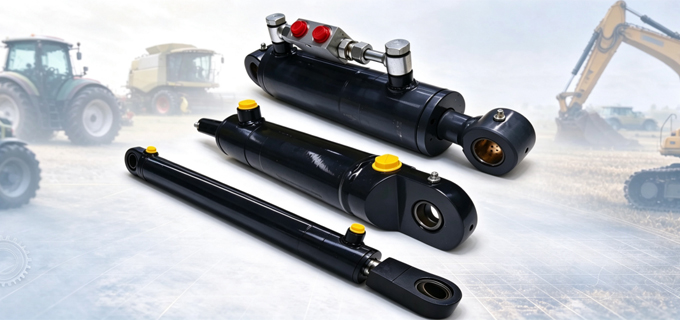
Engineered for the Field: Custom Single-Stage Hydraulic Cylinders for Tractors, Harvesters, Loaders, Trailers and Sanitation Vehicles
A Runhe Hydraulic White Paper — OEM Hydraulic Cylinder Design & Manufacturing, Factory-Direct from China
Hebei Runhe Hydraulic Machinery Co., Ltd. | www.hydraulicpumptech.com
Suggested meta description for web publishing (SEO): Runhe Hydraulic designs and manufactures custom single-stage hydraulic cylinders for tractors, combine harvesters, compact loaders, dump trailers, garbage trucks and sanitation vehicles. Application-matched engineering, OEM quality, competitive price, 15–30 day delivery. Your trusted hydraulic cylinder manufacturer in China.
Executive Summary
Hydraulic cylinders are the largest single component segment of the global hydraulics industry, and the market behind them is expanding steadily: valued at USD 16.9 billion in 2025, the global hydraulic cylinder market is projected to reach USD 24.7 billion by 2033 at a 5.0% CAGR (Grand View Research). The growth is concentrated exactly where Runhe Hydraulic works: mobile equipment accounts for 51.8% of demand, welded-body cylinders hold 53.6%, bores up to 150 mm cover 61.6%, and agriculture & forestry is the fastest-growing end-use segment at a 5.4% CAGR (Grand View Research, Fortune Business Insights).
For manufacturers of tractors, combine harvesters, compact loaders, dump trailers, garbage trucks and sanitation vehicles, the cylinder is not a commodity — it is a machine-defining component. A lift cylinder that drifts, a steering cylinder that leaks, or a compactor cylinder that fails mid-route costs far more than its purchase price. Yet many equipment builders still source cylinders in one of two painful ways: over-specified branded units at premium prices and long lead times, or generic catalog cylinders that were never designed for the machine's real duty cycle.
This white paper presents Runhe Hydraulic's alternative: application-engineered single-stage hydraulic cylinders, designed around each machine's actual working conditions — load spectrum, cycle frequency, mounting geometry, climate and contamination environment — then manufactured inside China's integrated hydraulic supply chain and delivered factory-direct in weeks. The result is the combination equipment OEMs and cylinder distributors are searching for: good quality, rational price, fast delivery, and one engineering partner for the whole hydraulic bill of materials — cylinders, gear pumps, gear motors and valves from a single accountable factory.
1. The Market Opportunity: Cylinders Are the Biggest Slice of a Growing Industry
1.1 A USD 17-billion market growing at 5% a year
Independent research houses agree on the trajectory. Grand View Research sizes the hydraulic cylinder market at USD 16.9 billion in 2025, USD 17.6 billion in 2026 and USD 24.7 billion by 2033 (Grand View Research); Fortune Business Insights places it at USD 17.34 billion in 2025 rising to USD 27.19 billion by 2034 at 5.2% CAGR (Fortune Business Insights); Polaris Market Research independently forecasts USD 25.48 billion by 2034 (Polaris). Within the broader USD 47.7-billion hydraulics market, cylinders are the dominant component segment (Precedence Research).

Two drivers matter most for Runhe's customers. First, rising mechanization of agriculture and forestry — tractors, harvesters, loaders, balers, sprayers — contributes +1.8 percentage points to market CAGR, ranking it the #2 growth driver industry-wide (Fortune Business Insights). Second, the expansion of waste-handling machinery and utility vehicles — the garbage trucks, compactors and sweepers that municipalities buy in every economy — adds a further growth contribution (Fortune Business Insights). Agriculture plus sanitation: precisely the machine families this white paper addresses.
1.2 The demand profile favors exactly what Runhe builds
Look at where market volume actually sits, and the picture maps one-to-one onto Runhe's product focus. Welded-body cylinders — the compact, durable design standard for mobile machinery — hold 53.6% of the market. Bores up to 150 mm, the range that covers virtually every tractor, harvester, loader and sanitation-vehicle function, account for 61.6%. Double-acting cylinders, the default for controlled lift/lower and push/pull work, take 71.6%. Mobile equipment applications hold 51.8% (Grand View Research).
Regionally, Asia-Pacific leads with 40.5% of 2025 revenue and serves as the world's manufacturing base for tractors, loaders, forklifts and special-purpose vehicles — with rising localization of hydraulic supply chains enabling shorter delivery cycles for OEMs sourcing there (Grand View Research, Fortune Business Insights). China alone represents an estimated USD 3.01 billion in 2026 cylinder revenues, roughly 16.6% of global sales (Fortune Business Insights). For a global buyer, the conclusion is straightforward: the world's cylinder capacity, cost structure and delivery speed increasingly live in China — and the winning strategy is to partner with a Chinese factory that engineers to your machine rather than sells you a catalog page.
2. Why "Application-Matched" Beats "Catalog-Standard" in Mobile Machinery
2.1 The real cost of a mismatched cylinder
A single-stage welded cylinder looks simple: tube, piston, rod, seals, two mounts. But mobile machinery punishes generic designs in predictable ways. Agricultural cylinders endure dust, mud, fertilizer corrosion, shock loads from implement engagement, and months of seasonal peak duty followed by idle storage — conditions that demand purpose-selected sealing systems, corrosion-protected rods and mounting geometry matched to the implement's kinematics (JRF Vérins). Garbage truck cylinders face a different punishment profile: thousands of high-frequency compactor and ejector cycles per week, side loads from uneven refuse, and exposure to corrosive leachate — which is why leading suppliers treat compactor, ejector and lifting functions as separate engineering cases with distinct bore, rod and seal specifications (HCIC).
When a catalog cylinder meets these duty cycles, the failure modes are familiar to every service manager: seal extrusion from pressure spikes the seal package was never rated for, rod scoring from inadequate wiper design in dusty fields, barrel fatigue at weld toes under shock loading, and mount bushing wear from geometry that fights the machine's linkage. Each failure costs the machine owner downtime and the OEM warranty budget and reputation. The engineering answer is not a "stronger" cylinder — it is a correctly matched cylinder: bore and rod sized to the load spectrum with the right buckling margin, seals chosen for the actual temperature and contamination range, mounts designed around the machine's real pivot geometry.
2.2 What proper cylinder engineering actually involves
Professional cylinder selection for mobile equipment follows a disciplined sequence — the same sequence Runhe applies to every custom project. Garbage-truck cylinder specialists, for example, standardize a five-step confirmation process: vehicle and application type first (rear/side/front loader; compactor, ejector or lifting function), then technical parameters (bore, rod, stroke, working pressure, mounting), then drawing review, then production with pressure and leakage testing, then export delivery (HCIC). Agricultural cylinder engineers similarly differentiate functions — three-point hitch cylinders for implement hooking, lifting cylinders for capacity, loader cylinders with double rods, cylinders with safety valves against hose-rupture drops (JRF Vérins).
This is the working method behind Runhe's "design to the working condition" promise. Before quoting, Runhe's engineers collect the machine type and function, the load and duty cycle, the envelope and mounting constraints, the climate range, and the hydraulic system pressure and flow. The cylinder that ships is then not an approximation but a matched component: right force, right speed, right life expectation, right price — no paying for steel you don't need, and no discovering at harvest peak that you needed it.
3. Application by Application: Where Runhe Cylinders Work
3.1 Tractors and agricultural implements
Tractor hydraulic cylinders are the core actuators of the machine's hydraulic system — driving implement lift, steering assist, front loaders and hitch control (Runhe Hydraulic). Runhe manufactures the full tractor cylinder set: three-point hitch and lift cylinders, loader boom and bucket cylinders, steering cylinders, and implement cylinders for plows, seeders, manure spreaders and harvesters. Runhe's own engineering content addresses each machine family specifically — from tiller and seeder cylinders (double-acting designs for two-way implement control) to plow lifting and flipping cylinders built for harsh field conditions with 100% unit-by-unit testing (Runhe Hydraulic, Instagram @Runhe).
For agricultural OEMs, two Runhe capabilities matter most. One is season-proofing: seal and surface-treatment selections that survive fertilizer chemistry, dust and −40 °C winters — Chinese manufacturers in this class now routinely specify −40 to 110 °C operating envelopes with innovative sealing packages (Junfu via Made-in-China). The other is batch consistency for production lines: a tractor plant ordering thousands of hitch cylinders per quarter needs identical ports, identical paint, identical test certificates every shipment — the discipline of an OEM supplier, which Runhe has practiced for over 12 years serving large domestic equipment manufacturers (Made-in-China company profile).
3.2 Harvesters, compact loaders and dump trailers
Combine harvesters concentrate a dozen cylinder functions in one machine — header lift and tilt, reel drive positioning, unloading auger swing, concave adjustment — each with distinct speed and force profiles. Compact loaders add the industry's most side-load-abusive application: bucket cylinders that see off-center loads every cycle. Dump trailers need hoist cylinders that deliver long stroke from a compact envelope, with pin-eye or trunnion mounts and single-acting gravity return; typical trailer cylinders in this class run 2,500–3,000 PSI working pressure with chrome-plated stages and SAE/NPTF porting (GD Hydraulic).
Runhe covers these functions with single-stage welded cylinders engineered per function — and where a machine needs more than cylinders, with the complete hydraulic set: cast iron gear pumps (Parker-interchangeable 315/330/350/365 and 020–076 series), gear motors, control valves and stacked valve solutions, so a trailer or harvester builder can consolidate the hydraulic bill of materials with one factory (hydraulicpumptech.com).
3.3 Garbage trucks and sanitation vehicles
Sanitation machinery is the harshest high-cycle environment in mobile hydraulics. A rear-loader compactor cylinder may cycle 30+ times per collection stop; ejector cylinders push full body loads against compacted refuse; hooklift and roll-off cylinders lift multi-ton containers daily. The sector's buying criteria are therefore explicit: compactor vs. ejector vs. lifting functions engineered separately, premium honed tube, induction-hardened chrome rods, and validated pressure/leakage testing per unit (HCIC, ZHY Hydraulic). Waste management is a recognized growth contributor to the global cylinder market (Fortune Business Insights), and refuse vehicle bodies are a standard application line for serious Chinese cylinder factories (GD Hydraulic).
Runhe builds for this duty: compactor, ejector, lifting, hooklift, sweep-and-wash and bin-lifter cylinders for garbage trucks, compression vehicles, road sweepers and sanitation equipment — including the hooklift cylinders for roll-off garbage trucks showcased in Runhe's own product media, with OEM/ODM production to customer drawings (Instagram @Runhe). For body builders and municipal fleet OEMs, the proposition is application-matched durability at a cost structure that keeps vehicle pricing competitive in tender-driven markets.
4. The Runhe Difference: Design Partnership, Not Just Supply
4.1 Engineering to your working conditions
Runhe Hydraulic — Hebei Runhe Hydraulic Machinery Co., Ltd., a subsidiary of Hanjiu Technology Group — is a hydraulic system solutions manufacturer with more than 12 years of experience and a track record as a recognized supplier to large domestic OEM equipment manufacturers (Made-in-China company profile). Beyond its standard cylinder series, Runhe provides custom production to customer drawings, with non-standard capabilities spanning special port forms, special materials, special mounting arrangements, special performance requirements and stacked hydraulic valve integration (Made-in-China company profile).
In practice, this means the conversation starts with your machine, not our catalog. A harvester builder describing header-lift drift under load gets a cylinder with the right cushion and counterbalance strategy; a trailer builder constrained by chassis depth gets re-optimized pin-eye geometry; a sanitation OEM fighting winter seal failures gets a low-temperature seal package. The output is a confirmed engineering drawing before production — the same drawing-review discipline that defines professional custom cylinder manufacture industry-wide (HCIC).
4.2 Quality you can audit, prices that make sense, delivery you can plan around
Runhe's quality system rests on advanced production equipment, 100% unit-by-unit testing of finished cylinders, and the operating philosophy the company states plainly: "survival by quality, development by integrity" (hydraulicpumptech.com, Instagram @Runhe). Material inspection, machining and welding control, and pressure/leakage testing before dispatch follow the standard QA sequence of serious export cylinder manufacture (HCIC).
The economics come from structure, not shortcuts. Chinese hydraulic manufacturers' integrated supply chains — foundries, precision tube and chrome-rod supply, heat treatment, seal and bearing ecosystems concentrated in the same industrial regions — typically deliver prices 20–40% below Western equivalents with fast, logistics-optimized delivery (StrongFlex). Comparable Chinese cylinder factories quote peak-season lead times of one month and off-season delivery within 15 working days, with minimum orders starting at a single unit (Junfu via Made-in-China); custom cylinder production across the sector typically ships in 20–45 days (Dallast). Runhe operates on the same supply-chain mechanics — which is why its delivery promises are measured in weeks while branded-channel buyers wait months.
4.3 One factory for the whole hydraulic system
Cylinders never work alone. Every cylinder function needs a pump to feed it, a valve to control it, and often a motor to complement it. Runhe manufactures the complete set — hydraulic cylinders, cast iron gear pumps (315/330/350/365 and 020/021/031/051/076 series, installation-compatible with Parker), gear motors and hydraulic valves — and supplies a full range of hydraulic components alongside (hydraulicpumptech.com, Made-in-China company profile). Its application footprint spans automation equipment, agricultural machinery, lifting machinery, engineering vehicles, intelligent storage systems, and port and marine equipment (Made-in-China company profile).
For an equipment OEM, single-factory consolidation means matched pump-cylinder sizing done by one engineering team, one quality standard across the hydraulic BOM, one warranty conversation, and one logistics stream. For a distributor, it means a broader sellable range — the customer who buys a garbage-truck cylinder today buys its gear pump next quarter — with private-label and OEM/ODM support throughout.
5. Specification & Ordering Guide: Getting Your Custom Cylinder Right the First Time
5.1 What Runhe's engineers need from you
The fastest path from inquiry to correct cylinder follows the industry's standard technical-parameter workflow (HCIC, Dallast):
Step | Information to provide | Why it matters |
1. Machine & function | Machine type (tractor / harvester / loader / trailer / garbage truck / sweeper) and cylinder function (lift, steer, compact, eject, tilt…) | Determines load spectrum, cycle rate and failure-mode priorities |
2. Core dimensions | Bore, rod diameter, stroke, retracted/installation length | Defines force, speed and envelope fit |
3. Operating conditions | Working pressure, duty cycles per day, temperature range, contamination/corrosion environment | Drives seal selection, surface treatment and safety margins |
4. Mounting & porting | Pin-eye / clevis / trunnion / flange; pin sizes; port type and position (SAE / NPT / BSPP / metric) | Guarantees bolt-on fit to your linkage and plumbing |
5. Volume & branding | Prototype vs. batch quantity, paint color, nameplate/private label, target delivery date | Aligns production scheduling and OEM branding |
A photo of the old cylinder, a machine model number, or a hand sketch with the key dimensions is enough to start — Runhe's engineers translate it into a confirmed production drawing for your approval before manufacturing.
5.2 Standard capability envelope
Runhe's single-stage welded cylinders cover the mainstream mobile-machinery envelope — the bore range up to 150 mm that alone represents 61.6% of global demand (Grand View Research) — in both double-acting configurations (the 71.6% market standard for controlled two-way work) and single-acting designs, the fastest-growing function segment at 5.7% CAGR thanks to demand in lifting platforms, agricultural attachments and dump equipment (Grand View Research, Fortune Business Insights). Typical construction follows the export-industry benchmark: precision cold-drawn seamless tube, hard-chrome ground and polished rods, polyurethane rod seals and wipers, and working pressures in the 16–22 MPa (2,320–3,200 psi) mobile standard (GD Hydraulic, Dallast) — with materials, seals and coatings upgraded where the application demands it.
5.3 For distributors: building a cylinder line with Runhe
Hydraulic cylinder distributors and resellers gain three structural advantages from a Runhe partnership: margin (factory-direct pricing on a 20–40% cost-advantaged supply base (StrongFlex)), range (one supplier covering agricultural, trailer, loader and sanitation cylinders plus the pumps and valves around them), and brand (OEM/ODM production with your nameplate, paint and packaging, as Runhe's custom-service model supports (Made-in-China company profile)). With mobile aftermarket demand described by industry distributors as steady and repeat-driven into 2026 and beyond (HydParts), a reliable custom-cylinder source is the foundation of a durable parts business.
6. Frequently Asked Questions (OEM & Distributor FAQ)
Can Runhe design a cylinder specifically for my machine, or only supply standard models?
Both. Runhe offers a standard cylinder series, but its core strength is custom design to the machine's working conditions — load, cycle frequency, mounting geometry, climate and contamination — including special ports, materials, mountings and performance requirements to customer drawings (Made-in-China company profile). Send your drawing, sample photos or machine model, and Runhe's engineers confirm a production drawing before manufacture.
Which machines do Runhe single-stage cylinders fit?
Tractors (hitch, loader, steering), combine harvesters (header, reel, auger), compact loaders (boom, bucket), dump trailers (hoist), garbage trucks (compactor, ejector, lifter, hooklift), road sweepers and sanitation vehicles, plus implements such as plows, seeders, tillers and manure spreaders (hydraulicpumptech.com, Runhe Hydraulic).
What quality assurance backs Runhe cylinders?
Every cylinder is tested unit by unit before dispatch, following the material-inspection → machining/welding → pressure and leakage testing sequence standard to professional export manufacture (HCIC, Instagram @Runhe). Runhe has supplied large domestic OEM equipment manufacturers for over 12 years under the principle "survival by quality, development by integrity" (Made-in-China company profile).
How fast is delivery, and what is the minimum order?
Runhe ships from inside China's concentrated hydraulic supply chain, where comparable factories deliver in 15 working days off-season to one month in peak season, and custom production typically ships in 20–45 days with minimum orders from a single unit (Junfu via Made-in-China, Dallast). Contact Runhe with your specification for current lead time and stock.
Does Runhe support OEM branding and private label?
Yes — OEM/ODM production with customer logos, paint colors and packaging is a standard part of Runhe's custom service model, consistent with its drawing-based customization offering (Made-in-China company profile).
Can Runhe supply the pumps and valves around the cylinder as well?
Yes. Runhe manufactures cast iron gear pumps (315/330/350/365 and 020/021/031/051/076 series, installation-compatible with Parker PGP patterns), gear motors, and hydraulic control valves including stacked valve solutions — enabling one-factory sourcing of a machine's complete hydraulic system (hydraulicpumptech.com, Made-in-China company profile).
7. Conclusion and Next Steps
The hydraulic cylinder market is growing at 5% a year toward USD 24.7 billion, and its fastest-growing segments — agriculture & forestry, single-acting designs, waste-handling machinery — are Runhe Hydraulic's home ground (Fortune Business Insights). Equipment builders no longer need to choose between expensive branded cylinders and risky generic ones: a third path exists, where the cylinder is engineered to the machine, built to OEM quality discipline, priced by China's supply-chain economics, and delivered in weeks.
That is the Runhe proposition for every tractor, harvester, loader, trailer, garbage truck and sanitation vehicle manufacturer — and for every cylinder distributor looking for a factory partner worth building a line on: matched design, proven quality, rational price, fast delivery, and the whole hydraulic system from one accountable source.
Start with one drawing. Send your cylinder specification, machine model, or even photos of the unit you want to replace — Runhe's engineers will return a confirmed design and quotation.
Hebei Runhe Hydraulic Machinery Co., Ltd. Website: www.hydraulicpumptech.com Email: admin@hydraulicpumptech.com | Tel/WhatsApp/WeChat: +86 199 3276 1114 Address: Shijiazhuang City, Hebei Province, China Product lines: single-stage & custom hydraulic cylinders, cast iron gear pumps, gear motors, hydraulic control valves, hydraulic components Serving: agricultural machinery OEMs, trailer & special-vehicle builders, sanitation equipment manufacturers, cylinder distributors worldwide
This white paper is provided by Runhe Hydraulic for general informational and marketing purposes. Market data are cited from the referenced third-party research publications; product capabilities should be confirmed with Runhe's engineering team for each specific application. All third-party trademarks mentioned belong to their respective owners and are referenced for identification only.