Maintenance Focus for Seeders' Hydraulic Cylinders: Preventing Abnormal Loading
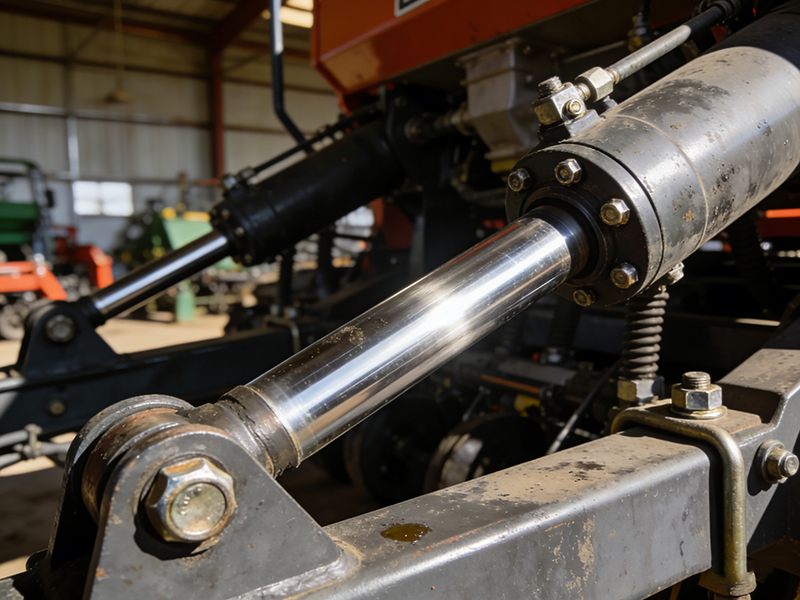
Maintenance Focus for Seeders' Hydraulic Cylinders: Preventing Abnormal Loading
Standardized operation and eliminating abnormal loading form the critical defense for protecting seeders' hydraulic cylinders and ensuring long-term stable, efficient seeding performance. Extra stress from improper operation silently compromises the cylinder's precision and lifespan.
Primary Sources of Abnormal Loading and Their Impact on Seeding Operations
1. Lateral Loads and Torsion During Contouring
Source: When individual seeding units independently contour uneven terrain, the hydraulic cylinder piston rod may undergo lateral bending or twisting forces beyond axial thrust due to ground irregularities.
Hazards: This causes uneven wear on piston rod and guide sleeve seals, leading to premature oil leakage. Simultaneously, it may deform the lifting linkage mechanism, compromising consistent seeding depth.
2. Asynchronous Loading During Multi-Cylinder Synchronized Lifting
Source: When multiple rows of a seeder lift or lower simultaneously, uneven loads or asynchronous movements across hydraulic cylinders—caused by uneven ground or mechanical jamming—can subject certain cylinders to tensile or compressive forces far exceeding design specifications.
Hazards: This readily leads to cylinder barrel deformation, mounting bracket fractures, and overall seeder frame distortion, compromising subsequent row spacing uniformity.
3. Extreme Position Impacts and Sustained Pressure
Cause: When adjusting seeding depth or locking the transport position to mechanical limits, continued hydraulic oil supply to the cylinder, or severe impacts at end positions caused by vehicle vibrations during transport.
Hazard: Repeated impacts can damage internal buffering structures and loosen mounting connections. Severe cases may result in loss of adjustment functionality, preventing precise seeding depth locking.
Key Operational Guidelines for Hydraulic Cylinders in Seeders
1. Pre-operation Inspection and Adjustment: Ensure all seeding units connect smoothly and contouring mechanisms move freely without binding. Uniformly inspect and preset the stroke and seeding depth for each hydraulic cylinder to minimize abnormal internal forces caused by adjustment discrepancies during operation.
2. Prioritize Synchronization Monitoring: During multi-cylinder lifting/lowering, observe whether all seeders simultaneously lift off or contact the ground. If noticeable asynchrony occurs (e.g., one side rising/falling first), immediately stop operation. Inspect and resolve mechanical jams or hydraulic line issues instead of forcing repeated cycles.
3. Strictly prohibit sustained pressure after mechanical limit: When the seeding depth adjustment reaches its position or the transport lock position (feeling mechanical hard limit), immediately stop operating the handle to prevent the system from generating high-temperature and cylinder impact due to sustained high-pressure overflow.
Proper operation is the foundation for achieving the best performance of Hydraulic cylinders for seeders. Hebei Runhe Hydraulic Machinery Co., Ltd. not only provides replacement cylinders matching or exceeding original equipment performance but also offers professional fault diagnosis and installation guidance, ensuring every row is planted with precision.
Choose Hebei Runhe Hydraulic Machinery Co., Ltd. to lay the precise, reliable foundation for your journey to a bountiful harvest.
slit seeder for lawn tractor
self propelled slit seeder
hydraulic slit seeder
toro slit seeder for sale
toro slit seeder price
slit seeder for tractor
commercial slit seeder
toro hydraulic slit seeder