Runhe Hydraulic Cylinders can precisely control the working depth of tillers.
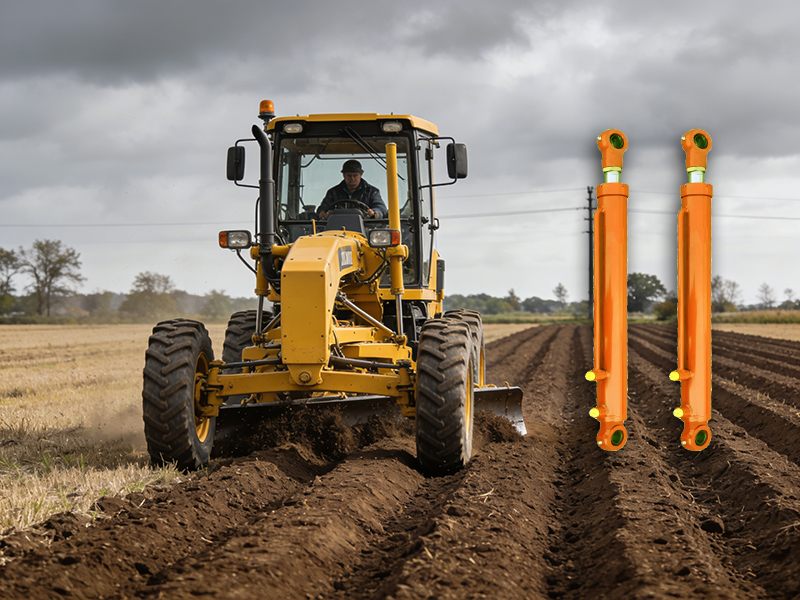
Hydraulic cylinders for tillers
First, Core Function and Working Principle
The hydraulic cylinder in a tillage machine serves as a critical actuator within the agricultural machinery's hydraulic system. Its core function is to convert hydraulic energy into mechanical energy, driving tillage components (such as plow blades, rotary tiller blades, subsoiler blades, etc.) to achieve elevation, angle adjustment, or depth control. This enables adaptation to varying soil conditions and tillage requirements. Its working principle is based on Pascal's Law.
Second, Types and Structural Characteristics of hydraulic cylinders for tillers
Classified by Operating Mode
1. Single-Acting Hydraulic Cylinder:
Characteristics: Hydraulic fluid acts on only one chamber, with the return stroke relying on external forces (e.g., springs, gravity). Features simple structure and low cost, but return speed is significantly affected by load.
Applications: Suitable for single-direction operations, such as lifting plow blades on tillage machines (Changzhou Weichi Hydraulic's CD series single-acting cylinders account for 65% of tractor suspension systems, weighing only 8.5 kg per cylinder—25% lighter than double-acting cylinders).
Limitations: Limited applicability in scenarios requiring precise control (e.g., combine harvester headers), with a 15% higher failure rate than double-acting cylinders (primarily due to return seal wear).
2. Double-Acting Hydraulic Cylinders:
Features: Utilizes dual oil circuits to control extension/retraction, enabling bidirectional force output and speed regulation with high control precision.
Applications: Dominates heavy-duty scenarios, such as corn header roller adjustment in harvesters and depth control in large seeders.
Cost: Complex structure increases unit price to 1.5-2 times that of single-acting cylinders, but integrated buffering extends service life to 3000 hours, resulting in lower overall costs.
Classified by Structural Type
1. Piston-Type Hydraulic Cylinders:
Structure: Composed of cylinder barrel, piston, piston rod, sealing devices, etc., categorized as single-rod or double-rod.
Features: High output force suitable for heavy-duty applications, though stroke length is limited by cylinder barrel dimensions.
Applications: Used in tillage machines to drive the lifting and lowering of plow blades or rotary cultivator blades.
2. Telescopic Hydraulic Cylinder:
Structure: Features two-stage or multi-stage pistons, extending in descending order of size and retracting in ascending order.
Features: Long stroke length, compact retracted profile, and space-efficient design.
Applications: Suitable for tillage machines requiring long strokes but with limited installation space (e.g., dump bucket lifting mechanisms).
3. Swivel Hydraulic Cylinder:
Structure: Generates torque and enables reciprocating swivel motion, available in single-leaf and double-leaf configurations.
Features: Suitable for applications requiring rotational movement, but with lower output force.
Applications: Rarely used in tillage machines; more commonly found in agricultural robots or automated equipment.
Third, Maintenance and Care
1. Regular Fluid Inspection:
Maintain hydraulic fluid cleanliness by periodically replacing fluid and filters to prevent contaminants and moisture ingress.
Recommendation: Inspect filter screens every 250 hours, replace filter elements every 500 hours, and clean filters and hydraulic systems every 1000 hours.
2. Seal Inspection:
Examine seals for wear, aging, or damage, replacing promptly to prevent fluid leakage.
3. Prevent Rust and Corrosion:
Protect exposed components like piston rods from prolonged exposure to damp or corrosive environments.
4. Operational Monitoring:
During operation, observe the hydraulic cylinder for abnormal noises, vibrations, or speed fluctuations. Shut down immediately for inspection and repair if detected.
Hydraulic tiller for sale
Hydraulic tiller attachment